
When Is Mold Remediation Required in Florida? A Naples Homeowner’s Guide
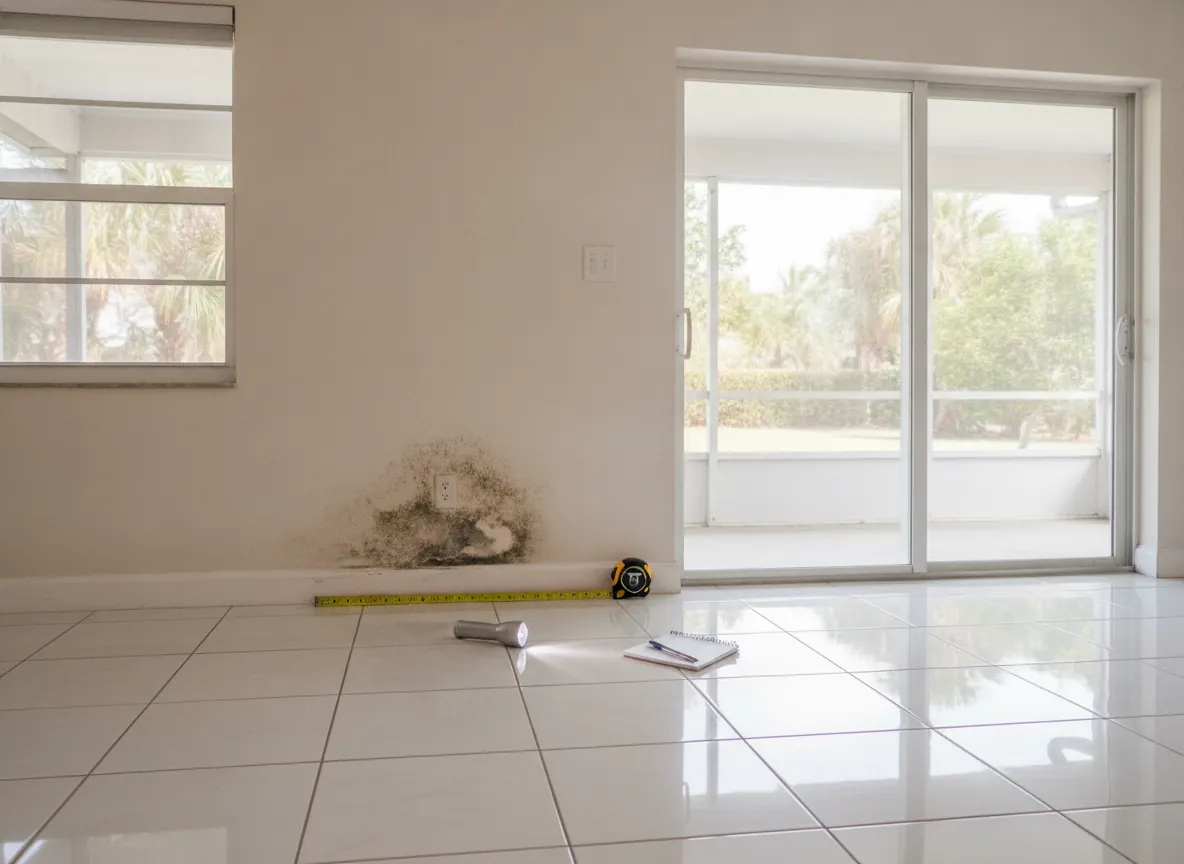
Florida law doesn’t order you to remediate mold in your own home. What it controls is who may do the work. Florida Statutes s. 468.8411 defines mold remediation as removing, cleaning, sanitizing, demolishing or otherwise treating mold or mold-contaminated material covering more than 10 square feet. Anyone who performs or offers to perform that work needs a state mold remediator license. EPA’s mold guide draws the do-it-yourself line in the same place: if the moldy area is less than about 10 square feet (roughly a 3 ft by 3 ft patch), a homeowner can usually handle it. In Naples, where the air is muggy almost all summer, that line gets crossed more often than people expect. This is general information, not legal advice.
The 10-square-foot line for mold remediation in Florida
Measure the visible growth, not the room. A ring of spots on a bathroom ceiling, a stained strip of baseboard behind a vanity, or mildew on one closet wall often adds up to less than 10 square feet. EPA says jobs like these are usually ones a homeowner can clean, with one condition it states bluntly: “If you clean up the mold, but don’t fix the water problem, then, most likely, the mold problem will come back.” A dripping AC drain line or a leaking supply line has to be fixed first.
Above 10 square feet, the statute applies. That usually means growth across a full wall section, behind kitchen cabinets, around an air handler closet, or along the lower drywall of a ground-floor room after flooding. During Hurricane Ian, the National Hurricane Center reported maximum inundation of 6 to 9 feet above ground in Naples. Wet lower walls in a single bedroom can pass 10 square feet fast. If the patch is close to the line, or you can’t tell how far it goes inside the wall, an inspection settles it. Our mold inspection and testing page explains what an assessor looks at.
Why Naples homes cross the line so easily
The main reason is the climate. We averaged NOAA hourly observations at Naples Municipal Airport from 2015 to 2024 (our own calculation, not an official normal). Dew points were 70°F or higher in about 99% of July and August hours and about half of all hours in the year. Average relative humidity was about 77%. LCEC’s vacant-homes guide notes that mold and mildew “can grow nearly anywhere if the relative humidity is consistently 70 percent or higher.” A small leak that might dry out on its own somewhere drier tends to keep spreading here.
Seasonal closures add to it. Census figures (ACS 2020–2024) show about 41% of all housing units in the City of Naples, and about 49% on Marco Island, are vacant for seasonal or occasional use. A slow drip under a sink in a home closed from spring to fall can grow well past 10 square feet before anyone walks in. That’s why so many first calls come in the fall, when owners come back. Our seasonal home mold page covers what to check on return.
Who does what: assessor, remediator and rebuild
Florida licenses individuals, not companies. The DBPR mold FAQ says the department does not license mold assessment or remediation businesses, and a license has been required since July 1, 2010. Before you hire anyone, ask for the person’s Florida license number and verify it at MyFloridaLicense.com.
Three separate roles often show up on one Naples job:
- The assessor inspects, finds the moisture source and writes a scope. Florida Statutes s. 468.8411 defines mold assessment as covering growth of more than 10 square feet.
- The remediator sets up containment, removes or cleans the affected material and dries the area.
- The rebuild contractor puts the walls, cabinets and flooring back. The statute says mold remediation may not include work that needs a chapter 489 contractor license unless the person holds one.
Florida’s 12-month rule keeps the first two apart. Under s. 468.8419, an assessor may not perform or offer remediation on a structure the assessor’s company assessed within the last 12 months, and remediators face the mirror rule. Division I contractors under s. 489.105(3) are the exception named in the statute. In practice, expect the inspection and the cleanup to come from different independent local companies. The mold removal page walks through what remediation usually involves.
Collier County permits for mold tear-out and rebuild
The state license question and the county permit question are separate. Collier County’s post-hurricane guidance says that “for the clean up and removal of wet drywall, cabinets, carpeting, and baseboards, permits will not be required,” but “a building permit is required for all repair, replacement and rebuild work.” Two more county rules matter for mold jobs:
- Non-fire drywall repair or replacement of no more than two sheets (64 sq ft) is exempt from permits.
- “All commercial and multi-family buildings will require a permit for any work performed.” About 60% of City of Naples housing units are in buildings with five or more units, so many condo owners fall under this. See our condo and HOA mold page.
For more detail, read do you need a permit to replace moldy drywall in Collier County. The City of Naples has its own building department, so owners inside city limits should check with the city before work starts.
Do you need mold testing before remediation?
Not always. EPA’s guide says that “in most cases, if visible mold growth is present, sampling is unnecessary.” Testing is more useful when you smell mustiness but can’t see growth, when you need a written scope for an insurer or a condo association, or when you want a check after the work is done. Typical national ranges from cost guides put a mold inspection at $450–$800, with a Florida average of about $739. These are not quotes. Our mold remediation cost guide shows the full table.
The short version for Naples homeowners
Under about 10 square feet, with the leak fixed, EPA says you can usually clean it yourself. Over that, Florida treats it as mold remediation, which a Florida-licensed remediator handles. An assessor and a remediator are usually separate companies, and the rebuild likely needs a Collier County or City of Naples permit. If you’re not sure which side of the line you’re on, request a free quote. Tell us what you’re seeing and we’ll help you get quotes from independent local companies. You can also call (239) 688-0131.
Can I remove mold myself in Naples?
If the moldy area is smaller than about 10 square feet, EPA’s mold guide says homeowners can usually handle it, provided the water source is fixed first. Above about 10 square feet, Florida Statutes s. 468.8411 treats the work as mold remediation, which a Florida-licensed remediator performs. This is general information, not legal advice.
Do I need a Collier County permit to tear out moldy drywall?
Collier County says removing wet drywall, cabinets, carpet and baseboards after a storm needs no permit, but repair, replacement and rebuild work does. Small non-fire drywall repairs of up to two sheets (64 sq ft) are exempt, and any work in a multi-family building needs a permit. Confirm your job with the county before work starts.
Can the same company test for mold and then remove it?
Usually not. Florida Statutes s. 468.8419 bars a mold assessor from remediating a structure the assessor’s company assessed in the last 12 months, and the same rule applies to remediators the other way. Division I contractors under s. 489.105(3) are an exception in the statute. Expect two separate companies.